A service business with several ways to be found
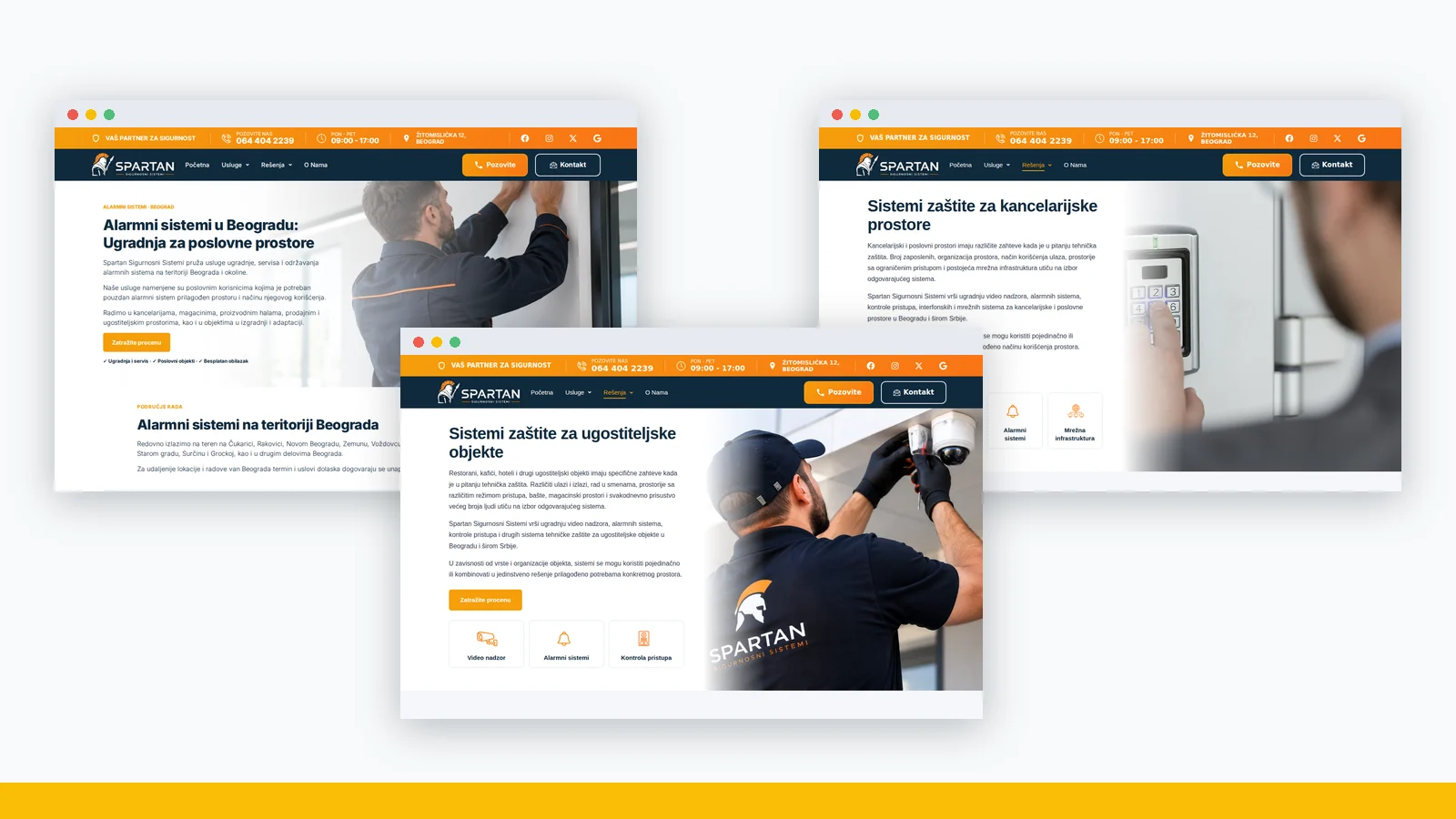
Spartan Sistemi provides alarm systems, video surveillance, and security for business premises from Belgrade, Serbia. The website needed to accommodate the different starting points of people researching those services, whether their search began with a city or a property.
The business goal was to compete for relevant searches in each location and property category. The intended sales use was equally specific: give the team an appropriate page to send when someone asked about a particular service.
That distinction shaped the assignment. A city page had to address a local service enquiry, while a property page needed to put the premises at the centre of the explanation.
I approached the work as an extension of the company’s service information. The collection needed enough structure to support those separate enquiries without becoming a set of disconnected additions.
Pages that belong to the main website
These WordPress service pages retain the full site navigation and footer. Visitors can examine a specific offer while keeping access to the wider company website, with routes to further information available around the service content.
The location coverage includes Belgrade, Novi Sad, and Niš. Alarm systems and video surveillance have their own city destinations, allowing the subject of a link to match the subject of an enquiry.
The property group covers office spaces, hospitality properties, warehouses and production halls, and buildings under construction. Each gives the business a place to present information around the setting in which its systems are needed.
A pricing reference sits alongside that service coverage in the overall delivery record. Its place in the project matters because the work began with learning how the official connection behaved before extending the approach.
Choosing automation around the client’s editor
I used Elementor MCP, the official connection through which an AI agent can create and change page components inside WordPress. The site owner must enable Elementor’s Atomic editor, also called V4, before that connection can perform this work.
For this assignment, the relevant benefit was the kind of structure left behind. The build method could produce components in the same visual editing environment the client would use afterward.
That made the choice more specific than adding AI to a website project. I needed an approach compatible with both repeated construction and the client’s future responsibility for the content.
An Elementor developer’s decision here concerns the entire working life of a page. A quick assembly method has limited value if the resulting arrangement creates an unnecessary obstacle to the next routine update.
Establishing the location pattern
Alarm systems Belgrade became the pattern for the location collection. Its structure contained 179 native, editable elements and seven native FAQ items, giving subsequent work a concrete example to follow.
The first location build therefore had a different responsibility from later pages. It established how the supplied material could be arranged inside the editor and how that arrangement worked within the existing site.
I used the completed example to write a build brief. Later city assignments could refer to that shared instruction instead of trying to reconstruct the approach from a short request.
For the client, this meant the series had a defined starting point. There was a reference against which I could assess a subsequent page’s structure, rather than treating every delivery as an unrelated interpretation.
Giving the complete service explanation room
The supplied Word document and the design image were separate inputs. The document held the final Serbian wording, while the image showed the intended presentation.
On the pattern page, I kept all 75 paragraphs of that copy. The abbreviated text visible in the image did not replace the fuller material written for the client.
That decision mattered because an attractive design reference does not establish how much information a business intends to publish. Here, the build needed to accommodate the actual explanation rather than fit only the shorter visual example.
My responsibility was to make those inputs work together. The finished structure had to carry the supplied service detail while retaining a layout that could be examined at different screen widths.
Dividing the work without dividing responsibility
Claude and Codex agents assembled later city pages from short Trello cards pointing to the brief. They could carry out those assignments unattended because the instructions referred to an established approach.
I remained responsible for reviewing and correcting each delivery. The agents provided execution capacity; I made the decisions about whether their output matched the assignment and what needed repair.
That division is relevant to a business owner commissioning a collection of related pages. It identifies where production work can be delegated and where someone still has to judge its suitability for the actual website.
My role also included investigating conflicts with the theme, resolving layout problems, and checking behaviour. Those activities connected the automated construction to the conditions under which the client’s visitors would encounter it.
The delivery sequence
The complete scope comprised 11 pages built between September 26 and October 12, 2026. The chronology below distinguishes the initial reference, the city coverage, and the property group without compressing the whole assignment into a single build session.
Each entry points to the delivered destination. Together they show the actual scope of the collection, including work outside the faster batches highlighted later.
- September 26, 2026, pricing reference: https://spartansistemi.rs/cenovnik/
- October 2, 2026 at 11:12, Belgrade alarm systems: https://spartansistemi.rs/alarmni-sistemi-beograd/
- October 2, 2026 at 12:15, Novi Sad video surveillance: https://spartansistemi.rs/video-nadzor-novi-sad/
- October 2, 2026 at 13:37, Niš video surveillance: https://spartansistemi.rs/video-nadzor-nis/
- October 5, 2026, Belgrade video surveillance: https://spartansistemi.rs/video-nadzor-beograd/
- October 12, 2026 at 07:19, office security: https://spartansistemi.rs/sistemi-zastite-za-kancelarijske-prostore/
- October 12, 2026 at 07:32, hospitality security: https://spartansistemi.rs/sistemi-zastite-za-ugostiteljske-objekte/
- October 12, 2026 at 07:45, warehouse and production hall surveillance: https://spartansistemi.rs/video-nadzor-magacina-i-proizvodnih-hala/
- October 12, 2026 at 08:10, protection during construction: https://spartansistemi.rs/sistemi-zastite-u-fazi-gradnje/
- October 12, 2026 at 15:00, Niš alarm systems: https://spartansistemi.rs/alarmni-sistemi-nis/
- October 12, 2026 at 15:00, Novi Sad alarm systems: https://spartansistemi.rs/alarmni-sistemi-novi-sad/
What the faster batches demonstrate
Seven service pages were built across two working days: the three city builds on October 2 and the four property builds on the morning of October 12. These were separate dates with other work between them.
The property batch took less than an hour to build. That describes a particular stage after the reference work, rather than the time needed to scope, investigate, check, and release an unfamiliar project.
For a buyer, the useful point is the relationship between preparation and repeated delivery. The build brief and working pattern gave subsequent assignments a clearer basis, so each did not begin with the same unresolved questions.
I would evaluate that pace in the context of the collection. It shows what became possible on this site once the approach was established, without turning one batch into a promise for every future brief.
Moving from construction to release
Every page originated on staging and was checked there before being pushed live. The development environment gave the work a place to be examined before it became part of the public site.
This sequence applied to familiar layouts as well as the first example. Similarity to an earlier page did not establish that the next one contained the right material or behaved correctly.
For a marketing director, staging provides a concrete version to inspect. It replaces an abstract description of what will be built with a page whose content and presentation can be assessed.
For an IT or digital leader, the same sequence separates an automated construction task from a public release. The connector’s ability to save something did not determine whether that thing was ready for visitors.
Checking the page people actually receive
The baseline checks used five widths: 375, 820, 1200, 1440, and 1920 pixels. I inspected the normal published address at those widths so the review covered the page as part of the functioning website.
Content checks confirmed the presence of every copy block. Interaction checks covered opening and closing each FAQ, while the technical inspection looked for horizontal scrolling and JavaScript errors.
Later pages received broader coverage across 19 screen sizes in Chrome and Safari’s WebKit engine. That work included actual taps on the mobile menu, extending the review beyond a static view of the layout.
These checks addressed different ways a page could disappoint a visitor. Complete text, usable controls, and a layout that fits the available screen each needed attention before I could accept the delivery.
Connecting the collection through the footer
I added the “LOKACIJE” city list and the “PO VRSTI OBJEKTA” property block to the footer. Those links make the new destinations reachable from every page on the site.
This gave the collection an explicit place in the website’s navigation. A visitor could encounter the location or property routes while browsing elsewhere, without needing to arrive through a search result.
The arrangement also makes the site’s service coverage visible as a group. Geography and premises remain separate organising ideas, so the footer does not require the visitor to interpret one mixed list.
I treated that connection work as part of delivery. Building an address and giving it a sensible place in the surrounding website are different tasks, and both mattered to this assignment.
What the team can change afterward
The client can work with the delivered elements through Elementor. A service description or FAQ remains part of the page’s editable structure, so routine content maintenance does not require operating an AI agent.
That distinction leaves the business with an ordinary editorial route after the construction work. The tool used during delivery does not have to become a new prerequisite for changing the wording.
Structural changes and technical styling still deserve appropriate care. The benefit is that the content itself lives in components the team can select and edit, while broader layout changes can receive technical attention.
I regard that division as part of a usable handover. A business should be able to understand where its ongoing editing happens and which kinds of changes call for technical help.
Reading the outcome accurately
The documented outcome is a delivered service collection and the implementation work behind it. Traffic, search positions, enquiries, and conversion changes have not been measured for these pages.
The SEO objective therefore remains distinct from an observed commercial result. Publishing a relevant destination creates something the business can use and evaluate, but it does not establish how much demand that destination will capture.
If you are considering a similar assignment, I can examine the relationship between your page scope, existing site, and intended editing process. Discuss your service page project: https://dejanmarkovic.com/lets-talk/